
Overview
@kb1slnlabs/dsh-ponytail
README / EN
Package documentation
Ponytail for DeepSeek Harness
An unofficial port of Ponytail 5.3.3 ("lazy senior dev mode") to the DeepSeek Harness (DSH). It keeps the upstream minimal-code rules exactly as written and adds native DSH surfaces: a settings tab, a mode picker, a status band in the composer, and a usage dashboard.
Upstream source: DietrichGebert/ponytail (MIT). This is an unofficial port, not affiliated with upstream.
Beta, tested on Windows with DSH 0.2.1-rc.3. Other platforms are untested.
Install
The examples below install into a CLI-managed profile called web. They need the
DSH 0.2.1-rc.3 CLI. If you use the desktop app, use its bundled CLI instead (see
"Desktop app" below). Close any running DSH process after installing, then start it
again.
Pick one of four sources:
Option 1 — Local link (development). From a checkout of this repository:
dsh plugin --profile web add "link:$PWD"
The plugin stays linked to your checkout; edits load on the next start.
Option 2 — GitHub source. Installs from this repository's source tree:
dsh plugin --profile web add github:KB1SLN-Labs/dsh-ponytail
Append #<commit> to pin a version.
Option 3 — Release tarball. Download the packaged file and install it:
# https://github.com/KB1SLN-Labs/dsh-ponytail/releases/download/v5.3.3-dsh.5/kb1slnlabs-dsh-ponytail.tgz
dsh plugin --profile web add file:./kb1slnlabs-dsh-ponytail.tgz
Save the tarball in a stable folder that will not be deleted — you need it again for
reinstall or upgrade. The URL is version-pinned on purpose: this release is a
prerelease, so a "latest" download link would not resolve to it. To build the same
tarball from a checkout instead, see Development; the package is plain
JavaScript, so npm pack needs no npm install first.
Option 4 — npm (recommended). Installs the published package:
dsh plugin --profile web add @kb1slnlabs/dsh-ponytail
Append @5.3.3-dsh.5 to pin this version.
Desktop app
The desktop app ships its own CLI. An older globally installed CLI refuses the
reserved desktop profile; the bundled one works. Use the bundled CLI with the
desktop profile and the ordinary install:
$dshDesktop = Join-Path $env:LOCALAPPDATA 'Programs\DeepSeek Harness\resources\runtime\cli\bin\dsh.cmd'
& $dshDesktop plugin --profile desktop add @kb1slnlabs/dsh-ponytail
The bundled CLI supports the same alternate sources shown above — github:, a
file: tarball path, or a local link: checkout.
Restart DSH, then open Settings → Plugins → Ponytail. Choose a default mode (for
example, ultra) and save. The package default is full. For details on profile
configuration and migration, see the adapter reference.
Everyday use
| Command | What it does |
|---|---|
/ponytail |
Opens the mode picker (when the UI is available) |
/ponytail lite / full / ultra / off |
Sets the mode for this session |
/ponytail status |
Shows the current mode and where it comes from |
/ponytail reset |
Drops this session's override |
Modes: lite, full (upstream default), ultra, and off.
There are also one-shot commands: /ponytail-review, /ponytail-audit,
/ponytail-debt, /ponytail-gain, /ponytail-help. The review, audit, and other
skill commands start model work. Mode and subcommands like status or help do
not.
Profile settings survive a restart. Session overrides set with /ponytail <mode> reset
when the process restarts. See the default precedence
reference for environment and global
defaults.
Screenshots
Both images show demonstration data rendered through the actual plugin components.
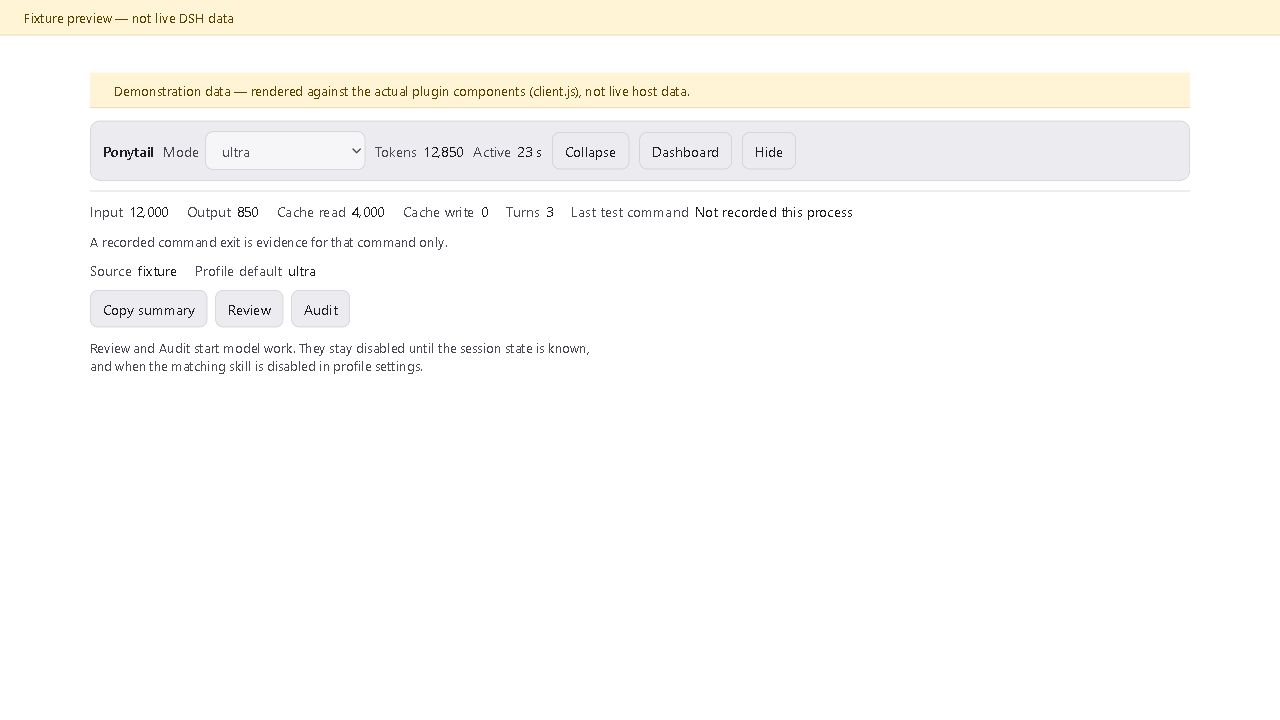
Status band (expanded): Demonstration data.
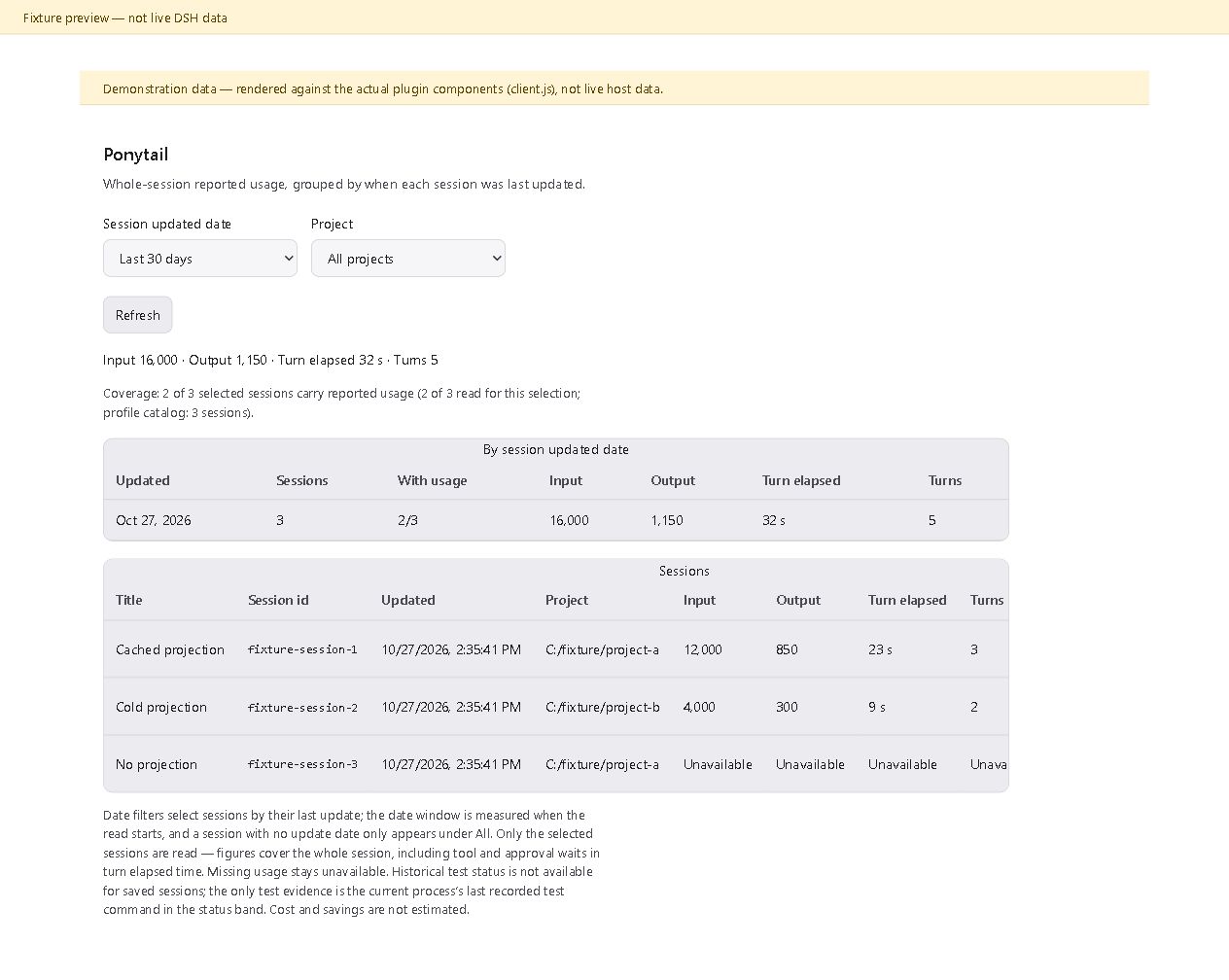
Dashboard: Demonstration data.
What the numbers mean
- The dashboard shows whole-session usage as reported by the provider, grouped by the date each session was last updated. Filters decide which sessions get read; sessions with no update date appear only under All.
- Sessions without usable usage are listed as unavailable, and coverage counts say how many of the selected sessions carry usage.
- Active time is completed-turn elapsed time and includes waiting on approvals and tools.
- The test command shown in the status band is the current process's last recorded simple foreground test command. Its exit code is evidence for that command only, not proof about a whole suite.
- No cost or savings estimates are made for your sessions.
/ponytail-gainshows the upstream benchmark reference.
Details on history semantics, contracts, and limitations: adapter reference, DESIGN.md, PRODUCT.md.
Coming from another adapter
If @mengyuly/dsh-ponytail is installed, remove that plugin first, then follow the
migration section of the reference
to replace its override row and keep your settings.
Development
To run the tests, point DSH_ROOT at the directory of an external rc3 host DSH
package install:
$env:DSH_ROOT = '<abs path to the @deepseek-ai/dsh package dir>'
npm test        # node --test "test/*.test.mjs" — 64 checks, no model calls
See validation scope for what has and has not been verified.
License
MIT. This port vendors upstream Ponytail (MIT) at a pinned commit; see LICENSE
and the adapter reference for exact provenance.
LIMITATIONS
Known limitations
Submitted through a public pull request. Automated checks verified the public bundle contract and committed files, but did not inspect runtime capabilities. This is not a human review, security audit, publisher identity check, or official endorsement.